A knitting chart is the pattern drawn as a grid. Each square is one stitch, each row of squares is one row or round of knitting, and a key says what each symbol or colour means. Once you know which corner to start in and which way to read, a chart is faster to follow than written instructions, and it shows you the fabric before you knit it.
The grid and the key
- One square, one stitch. The square stands for the stitch you work into it, not for a measurement. Real stitches are wider than they are tall, which is why a chart drawn in squares looks taller than the knitted piece.
- Row numbers on the edges. They show where each row starts.
- The key. It lists every symbol or colour in the chart. Two charts can use the same symbol for different stitches, so read the key of the chart in front of you, not the last one you used.
- Repeat boxes. A bold outline around part of the chart marks the stitches you repeat across the row. Work any stitches before the box once, the box as many times as the pattern says, then the stitches after it.
Knitting flat: the rows zigzag
Start at the bottom right corner with row 1. In flat knitting you turn the work at the end of every row, so the reading direction changes:
- Right-side rows (usually the odd ones) are read right to left, the same way the stitches come off your needle.
- Wrong-side rows (usually the even ones) are read left to right.
The row numbers follow you: odd numbers on the right edge, even numbers on the left.
On wrong-side rows the symbols still show how the stitch looks from the right side. In most keys an empty square is “knit on the right side, purl on the wrong side”. You knit the empty squares on row 1 and purl them on row 2, and the result is stockinette. The key usually says this in two parts: “RS: knit, WS: purl”.
Knitting in the round: every round right to left
In the round the right side always faces you and you never turn the work, so every round is read right to left, starting from row 1 at the bottom. The row numbers usually all sit on the right edge. An empty square is a knit stitch on every round.
Rib, seed and texture
Texture charts use symbols for knit and purl as they look from the right side. A 2×2 rib in the round is two knit squares and two purl squares, repeated: you knit the knits and purl the purls on every round. Worked flat, the wrong-side rows read left to right and every stitch flips, which gives the same rib on the right side.
Colourwork and floats
In a colourwork chart each square is coloured instead of carrying a symbol, and you work it in that colour. In stranded colourwork such as Fair Isle the colour you are not using runs along the back of the work as a float.
Look along each row before you start. A long run of one colour means a long float behind it, and long floats pull the fabric in and snag. Many designers keep runs to about five stitches, or plan to catch the float behind a stitch in the middle of a long run. Marking those places on the chart before you cast on saves unpicking later.
Make your own chart
The free knitting chart maker draws a chart in the browser and prints it, and the photo to knitting chart tool turns a picture into a colourwork grid. Before you cast on, the gauge calculator and the cast on calculator turn a chart into a stitch count at your gauge.
Seeing the chart as fabric in İlmek
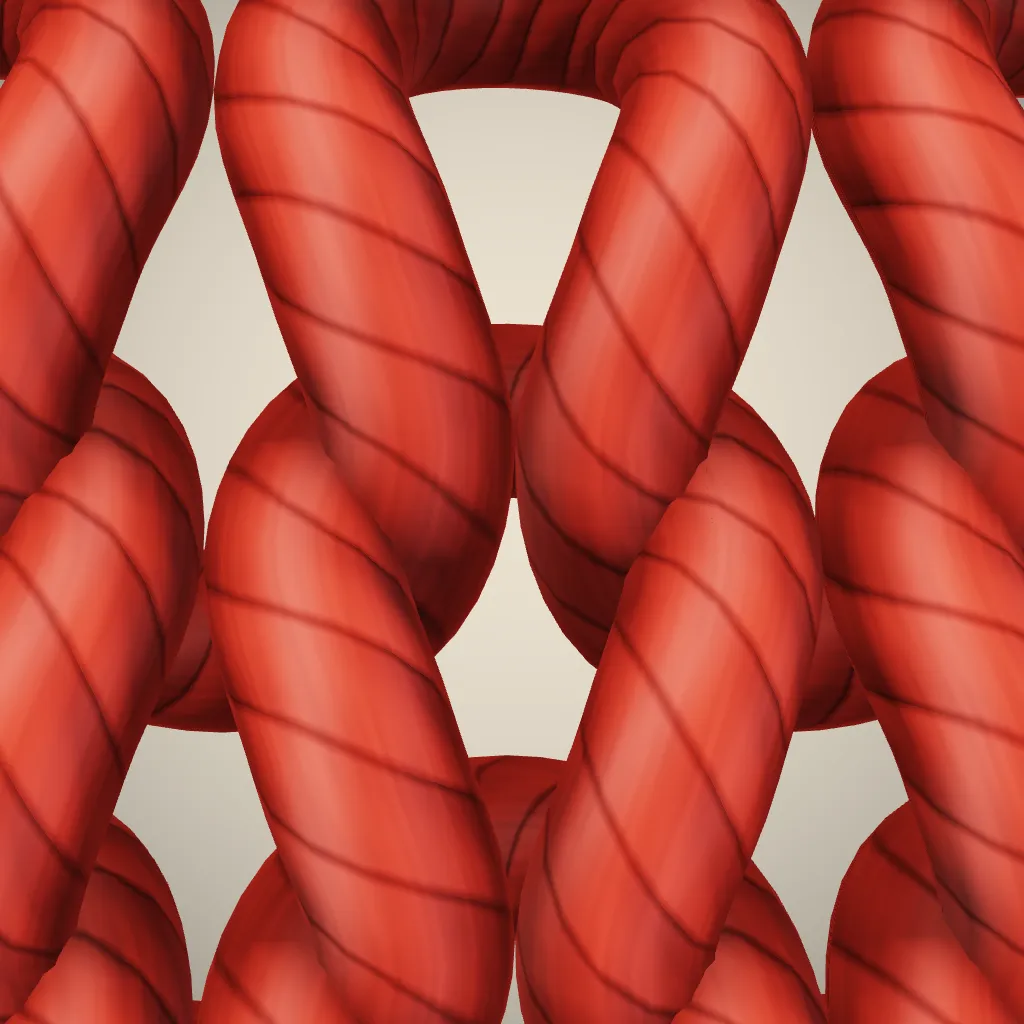
A flat chart cannot show how the colourwork will sit or how hard the floats will pull. İlmek draws the chart as relaxed 3D yarn while you edit it: knit, purl, colourwork, ribs and Fair Isle, with your choice of fibre, ply and colour. Long floats, stranded floats and unbound ends are flagged on the chart as you work, before you cast on, not after.
It charts weaving, crochet and Turkish oya lace in the same editor, with pencil, line, fill, mirror symmetry and undo, and 50 templates to start from, among them stockinette, garter, seed, 2×2 rib and Fair Isle. Everything runs on the device, with no account.
İlmek’s own introduction is İlmek: Knitting, Crochet & Weaving Charts in 3D.